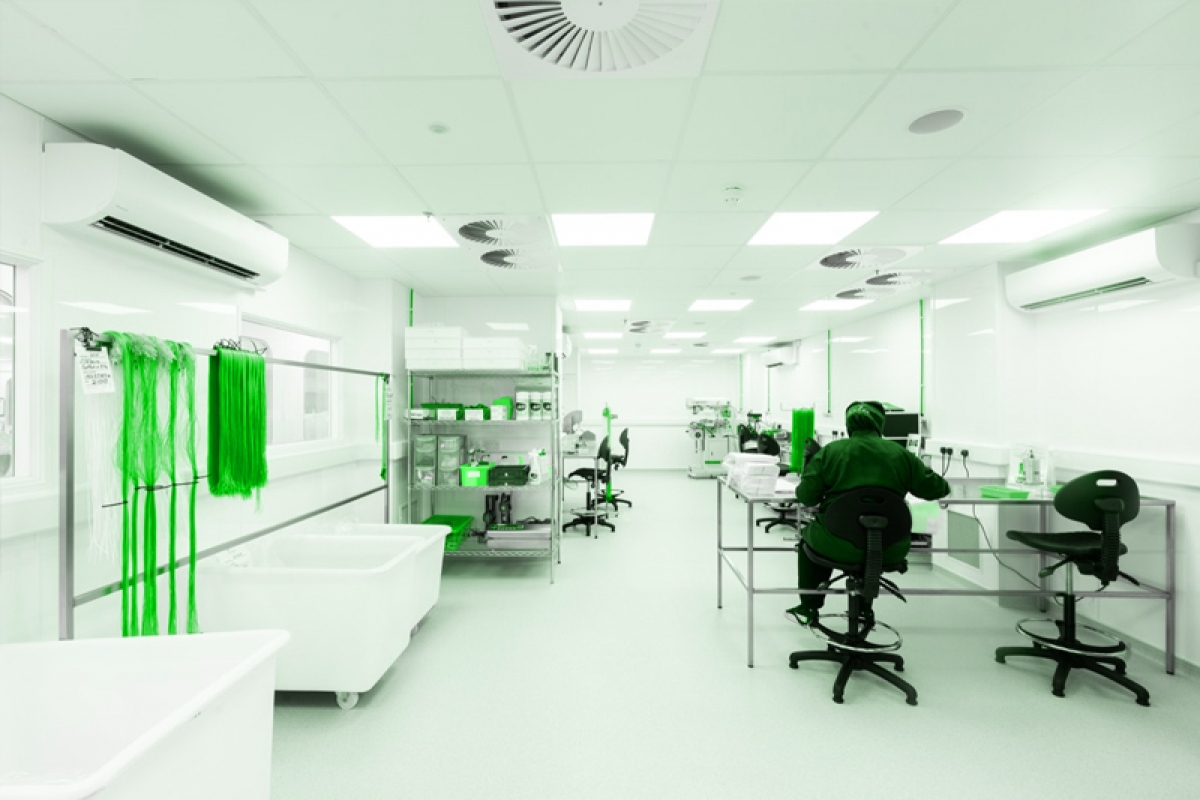
A clean room is a room in which airborne particulates, contaminants, and pollutants are kept within strict limits. For example, in the electronics industry, clean rooms are used in the manufacturing of printed circuit boards, integrated circuits and PC hard drives. The purpose of the cleanroom is to control an environment by limiting the presence of micron and submicron particles and controlling environmental conditions such as temperature and humidity. The level to which the environment/particle count/air changes per hour is controlled and thus determines the cleanroom classification.
How do cleanrooms work?
Cleanrooms use High Efficiency Particulate Air (HEPA) filters located in the ceiling to remove particles out of the air. HEPA filters are 99.99% effective at eliminating contaminants from the air, such as dust, pollen, bacteria, mold, and other airborne particles.
Who uses cleanrooms?
Electronics, Aerospace, Medical Device and Pharmaceutical industries are the biggest cleanroom users.
What are the different types of cleanrooms?
Modular Cleanroom
A modular cleanroom is a cleanroom built using prefabricated modular components then assembled on-site. Modular cleanrooms can be manufactured and installed 50% faster than stick built conventional construction cleanrooms. Unlike conventional construction cleanrooms, modular cleanrooms are easily modified, expanded, or relocated.
Stick Built Cleanrooms
Stick built cleanrooms are built from scratch on site. All the different trades and materials result in a more time-consuming and dirty installation process.
Softwall Cleanrooms
Softwall cleanroom is a cleanroom created by hanging clear vinyl curtains on an aluminum frame to create walls. It can be mounted on casters to be easily relocated. Softwall cleanrooms can only be one pass.
Why does my cleanroom need a gown room?
The cleanroom gown room prevents contamination and particles from outside the cleanroom from entering the cleanroom when personnel enters or exits the cleanroom. An airlock system will also help maintain the controlled temperature of a cleanroom space.
What is cleanroom flooring?
Most factories have bare concrete floor which is very porous and particulates. In order to reach the desired cleanroom class, it is usually necessary to install either an epoxy, heat welded vinyl or industrial VCT floor over the concrete to eliminate particulates. The choice of cleanroom flooring is driven by cost, cleanroom class and chemical resistance to cleaning chemicals.