About The Author

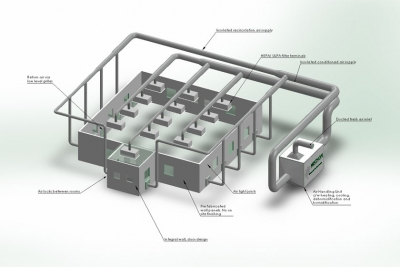
Five stages control at construction
As the demand for complex cleanrooms in the life sciences grows, construction challenges mount. Making the right decisions during the building and commissioning phases of cleanrooms will help to ensure that they are successful, better integrated, more operable and sustainable. Generally speaking, teamwork among designers, operators, maintenance people and builders that focuses on project timelines will achieve the best results. The suggestions below will help drug and device manufacturers step back and better envision the whole facility during the build process.
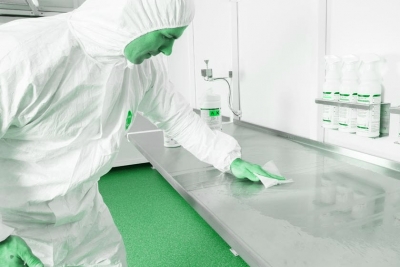
Principal of control at operation stages
A cleanroom is any given contained space where provisions are made to reduce particulate contamination and control other environmental parameters such as temperature, humidity and pressure. The key component is the High Efficiency Particulate Air (HEPA) filter that is used to trap particles that are 0.3 micron and larger in size. All of the air delivered to a cleanroom passes through HEPA filters, and in some cases where stringent cleanliness performance is necessary, Ultra Low Particulate Air (ULPA) filters are used.
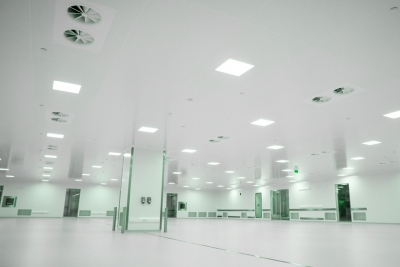
Understanding of Cleanroom
A room in which the concentration of airborne particles is controlled, and which is constructed and used in a manner to minimize the introduction, generation, and retention of particles inside the room and in which other relevant parameters, e.g. temperature, humidity and pressure are controlled as necessary.
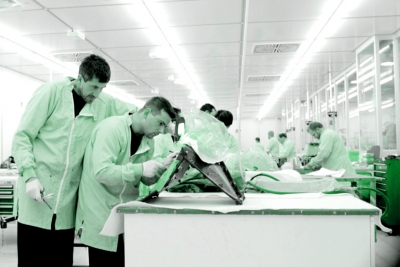
Industrial Cleanroom (ICR)
Classification of Cleanroom based on Functionality
Cleanrooms are used in practically every industry where small particles can adversely affect the manufacturing process. They vary in size and complexity, and are used extensively in industries such as semiconductor manufacturing, pharmaceuticals, biotech, medical device and life sciences, as well as critical process manufacturing common in aerospace, optics, military and Department of Energy.
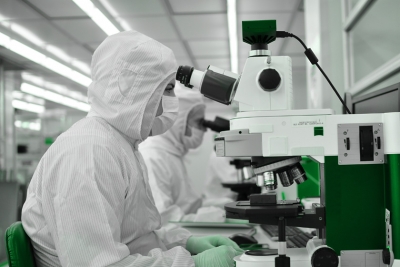
Biological Cleanroom (BCR)
Classification of Cleanroom based on Functionality
Typically used in manufacturing or scientific research, a cleanroom is a controlled environment that has a low level of pollutants such as dust, airborne microbes, aerosol particles, and chemical vapors. To be exact, a cleanroom has a controlled level of contamination that is specified by the number of particles per cubic meter at a specified particle size. The ambient air outside in a typical city environment contains 35,000,000 particles per cubic meter, 0.5 mm and larger in diameter, corresponding to an ISO 9 cleanroom which is at the lowest level of cleanroom standards.
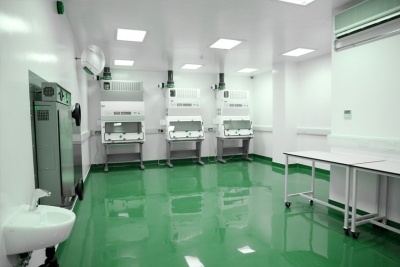
Basic elements of Cleanroom
FAB Cleanroom
In the microelectronics industry a semiconductor fabrication plant (commonly called a fab; sometimes foundry) is a factory where devices such as integrated circuits are manufactured.
A business that operates a semiconductor fab for the purpose of fabricating the designs of other companies, such as fabless semiconductor companies, is known as a foundry. If a foundry does not also produce its own designs, it is known as a pure-play semiconductor foundry.
Fabs require many expensive devices to function. Estimates put the cost of building a new fab over one billion U.S. dollars with values as high as $3–4 billion not being uncommon. TSMC invested $9.3 billion in its Fab15 300 mm wafer manufacturing facility in Taiwan.[1]