About The Author

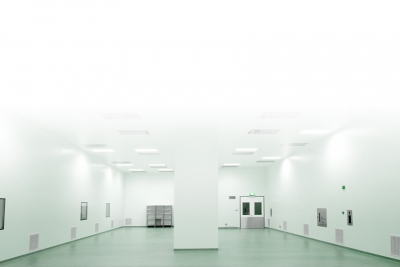
Comply to Building Code
Complying to Code is easy if you plan ahead.
Eight different cleanroom panels that help you meet Building Code. CRW stocks a full line of 2″ and 4″ Flex Wall Panels. Now you have the option of Class A through C wall panels constructed in eight models, all of which comply with Building Code!
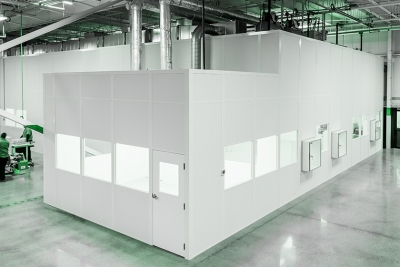
Why do I need a cleanroom?
The Cleanroom
The purpose of every cleanroom is to control an environment by limiting the presence of sub-micron particles and modifying inadequate environmental conditions. The level to which the environment is controlled is what separates one cleanroom from another. For instance, a Class 10 cleanroom has 10 particles of size 0.5 microns per cubic foot of air, where as a Class 100,000 cleanroom has 100,000 particles of size 0.5 micron per cubic foot of air.
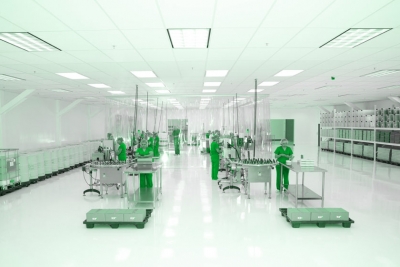
Moving Optical Networking
As the global appetite for sending and receiving voice, data and video continues to increase, networks will need to become more powerful and more efficient to keep pace.
In turn, optical networks require optical switch systems that directly route multi-wavelength photonic signals between thousands of different destinations, or ports. Recent estimation of the worldwide market for optical switch systems is forecasted to grow from $234 million in 2000 to $7.4 billion by 2004.
The healthy projections have yielded many new facilities, and a Southern California based company recently completed a fab for the production of micro electro-mechanical systems (MEMS) optical switches, the basis for communication over a telecommunications network.
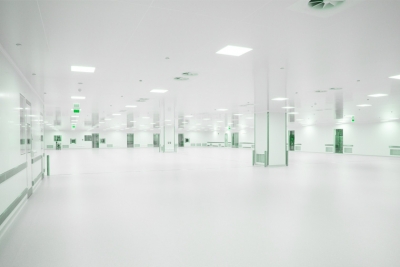
Air Flow & Ceiling Filter
Air Flow Rates
For detailed information on Air Flow Velocity Rates, contact a our specialists to get specific answers to your project.
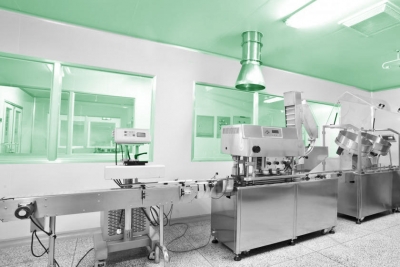
Positive Air Pressure Cleanrooms
Cleanrooms are classified into 2 categories of air pressurization, positive and negative air pressure cleanroom HVAC (Heating, Ventilating and Air Conditioning) systems. Positive air pressure cleanrooms systems are normally used for Electronics, Aerospace, Optics, Military and Defense applications, and Research, etc., where the air escaping from doors, ceilings, or walls, due to the positive air pressure, is not hazardous and not creating safety or health concerns. The amount of particulate cleanliness required determines the cleanroom design concept, amount of air filtration, CFM (cubic feet per minute) and total HVAC. Our positive pressure cleanroom designs are based on years on experience in air pressurization in a vast variety of applications.
Positive Air Pressure Cleanrooms normally operate in an air pressure range of 0.02 in. to 0.2 in water column (H20). Positive air pressure means the cleanroom or rooms are "pumped up” with more filtered air then the surrounding space outside the cleanroom(s). There are different cascading levels of positive air pressure from the cleanest rooms at the highest pressure down to the gown room/or airlock room.
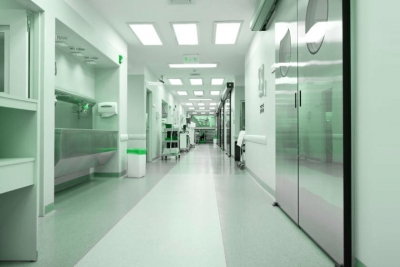
Negative Air Pressure Cleanrooms
Negative air pressure cleanrooms are used for hazardous manufacturing processes using corrosive, flammable and/or potentially explosive chemicals.
Negative air pressure cleanrooms are also used for BSL level P - 2, P - 3, and P - 4 Bio-Safety cleanrooms for production and medical research.
Negative Air Pressure Cleanrooms - Hazardous Process and "Explosion Proof” Facilities
Some cleanrooms are required to be operated at negative air pressure for hazardous processes using chemicals, flammable and potentially explosive liquids and powders, to prevent these chemical or powders from escaping into the surrounding space.