About The Author


Cleanroom Cleaning
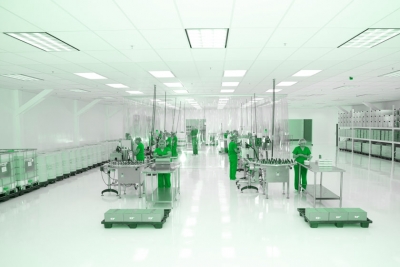
Cleanrooms are highly controlled manufacturing areas designed to limit the amount of contamination. Federal standard 209E classifies cleanrooms by the concentration of air particles 0.5 micron in diameter or larger. (An average human hair is about 50 microns in diameter.)
A Class 1000 cleanroom, for example, has fewer than 1000 of these particles in a cubic foot of air, while a Class 10 cleanroom has fewer than 10 particles less than or equal to 0.5 micron in diameter per cubic foot.

Cleanroom Maintenance
Regular maintenance procedures-daily, weekly, monthly, and quarterly-help ensure cleanroom compliance, no matter what the cleanroom class. For example, positive-pressure air should be running at full-flow in a Class 10 cleanroom for at least 30 min before cleaning to ensure clean, fresh air within the room. Cleaning starts at the highest point and works toward the floor. Every surface, corner, and ledge are first vacuumed, then damp-wiped with a cleanroom wipe. Operators wipe surfaces one way-either downward or away from themselves-since a "back-and-forth" scrubbing motion can create more particles than it removes. They also use a clean surface of the wipe or sponge with every new stroke to guard against redeposition of contaminates. On walls and windows, the wiping movement must be parallel to the airflow.
Cleanliness Control
As with cleanroom operations, cleanliness is a four-part equation: environment, process, tools, and people. How stringent clean manufacturing guidelines need to be is based on the products and customer requirements.
Controlling air temperature and humidity levels in all work areas is a good first step in clean manufacturing. It may eliminate the need to open windows, which would admit outdoor airborne dirt.

The Bare Necessities
The supplies needed for cleaning a facility will vary according to the cleanroom’s classification and purpose, but there are certain materials that every facility should use.
Cleaning a home requires a collection of mops, vacuums, wipers, and cleaning agents. Similarly, cleanrooms require different tools for different cleaning tasks. Wipes and swabs clean small areas; mops are dedicated to larger surfaces. Cleaning solutions should be formulated to the task. Vacuum cleaners, non-shedding mops, and sticky rollers are other necessities.

Reduce Risk of Contamination
Contamination control is easier than detection because you cannot test for every impurity. Even if a product does not come in direct contact with the cleanroom environment, it is still influenced by it. Convection and circulating air can carry particulates and microbes, while handling can transfer residue. Thorough cleaning and disinfection of the environment minimizes the potential for contaminants to adversely affect product quality.

Clean Room Terminology
What is a Cleanroom?:
An enclosed area that’s controlled environmentally over atmospheric contamination, temperature, pressure and, often, humidity.
What is a Cleanroom Air Lock:
A room attached to the Cleanroom. This room has interlocking doors and its function is to act as a buffer zone between the cleanroom and the outside atmosphere, during the transfer of material or personnel. It helps keep the cleanroom pressurized and free from infiltrating dirt.