About The Author

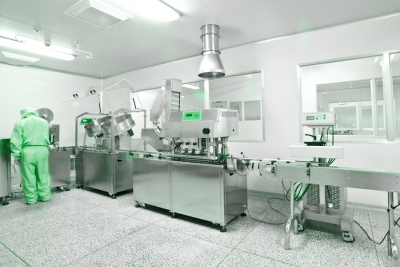
Types of cleanroom
Cleanrooms have evolved into two major types and they are differentiated by their method of ventilation. These are turbulently ventilated and unidirectional flow cleanrooms. Turbulently ventilated cleanrooms are also known as ‘nonunidirectional’. Unidirectional flow cleanrooms were originally known as ‘laminar flow’ cleanrooms. The unidirectional type of cleanroom uses very much more air than the turbulently ventilated type, and gives a superior cleanliness.
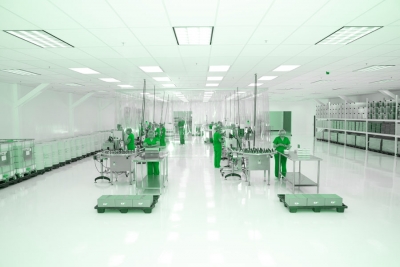
Types of Cleanrooms
Cleanroom facilities incorporate a variety of preventative materials, equipment and devices to maintain a highly clean, germ-and-bacteria-free environment. Some of this equipment is for extensive personnel protection, while other pieces are designed to maintain clean air in the workplace. Cleanrooms are typically used for manufacturing and scientific research operations that require processes or materials that are incredibly sensitive to dust, static electricity, or various types of microparticles and microorganisms. For instance, computer parts often have small parts that cannot be contaminated by dust before they are assembled into a final housing.
Cleanrooms are used for production and research and commonly featured elements such as HEPA (highly-efficient particulate air) filters, air showers, special garments for workers to wear, and anti-static devices in order to limit contamination or damage to the workplace environment. Because of the varied nature of cleanroom work, cleanroom facilities are available in portable and modular designs as well as fixed building structures.
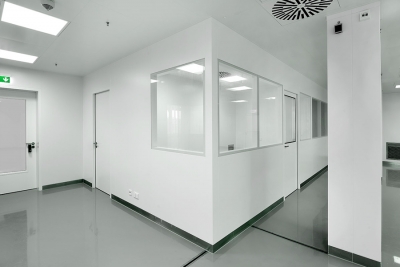
Costing a cleanroom
There are many reasons why it is impossible to give a cleanroom cost as a price per square foot straight off — the main one being there are many variables to take into consideration. The objective in giving a price is to provide a fair costing for your project without endless extras. To do so, requires some preliminary engineering. A construction company would need to evaluate the design and make some calculations (mechanical and electrical). Engineers also might like to challenge the design, clarify any misconceptions and eliminate unnecessary spending. In other words, the company does not have a catalogue with prices for different types of cleanrooms; costing requires some preliminary engineering and computing before a price can be given.
If a supplier were to give you a quick price per square foot, you would be advised to run! Costs related to that cleanroom would be likely to snowball. The price quoted would be like a basic car cost, with roll down windows, no air conditioning and no radio. You do not want that in a cleanroom, so beware!
That being said, here are some aspects that influence the price per square foot of a cleanroom.
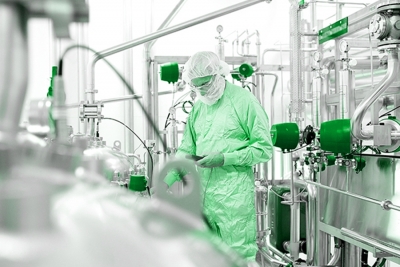
Cleanroom Classifications (ISO 5-8)
Cleanrooms are classified according to the cleanliness level of the air inside them. The cleanroom class is the level of cleanliness the room complies with, according to the quantity and size of particles per volume of air. The primary authority in the US and Canada is the ISO classification system ISO 14644-1. This standard includes the cleanroom classes ISO 1, ISO 2, ISO 3, ISO 4, ISO 5, ISO 6, ISO 7, ISO 8 and ISO 9, with ISO 1 being the “cleanest” and ISO 9 the “dirtiest” class (but still cleaner than a regular room). The most common classes are ISO 7 and ISO 8.
The old Federal Standard 209 (class 100,000; 10,000; 1,000; 100; 10; 1) was withdrawn in 2001 and officially replaced by ISO-14644-1 in 1999, but it is still widely used.
In addition, cleanrooms must also comply with industry-specific and regional standards. For example, EU GGMP (A-B-C-D) applies to pharmaceutical products and USP (795, 797 and 800) to compounding pharmacies.
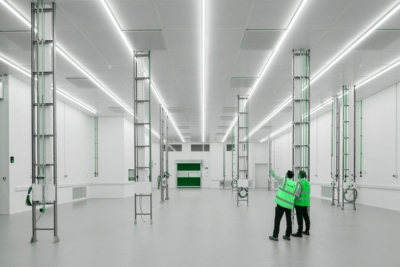
Cleanroom Design in 10 Easy Steps
"Easy" may not be a word that comes to mind for designing such sensitive environments. However, that doesn't mean you can't produce a solid cleanroom design by tackling issues in a logical sequence. This article covers each key step, down to handy application-specific tips for adjusting load calculations, planning exfiltration paths, and angling for adequate mechanical room space relative to the cleanroom's class.
Many manufacturing processes need the very stringent environmental conditions provided by a cleanroom. Because cleanrooms have complex mechanical systems and high construction, operating, and energy costs, it is important to perform the cleanroom design in a methodical way. This article will present a step-by-step method for evaluating and designing cleanrooms, factoring in people/material flow, space cleanliness classification, space pressurization, space supply airflow, space air exfiltration, space air balance, variables to be evaluated, mechanical system selection, heating/cooling load calculations, and support space requirements.
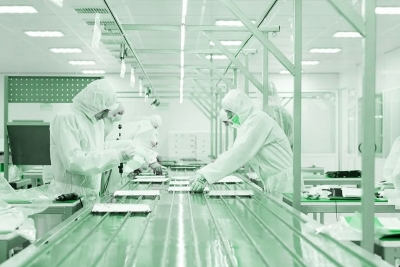
Cleanroom Basics
Contaminants can cause a variety of defects when assembling or packaging sophisticated products such as medical devices. If the cleanliness of the product is important, increasingly they are assembled and packaged in cleanrooms. The environment is controlled where particulates in airflow are filtered and the particulates analyzed by size and number, thus controlling the airborne particles to meet predetermined limits.